

The World is Upside-Down
From ancient ritualistic origins, the use of artifice to package the truth has been an enduring custom of culture—but it's only serious if there's laughter involved.

Masks have the power to embody our real self as we switch context—a time to lose control, and a time to regain it. This is an edited, literary version of a longer essay on the importance of the community ritual of Carnival.
A fog had descended on the city the moment we came down the long steps of the train station. Venice appeared veiled in a protective cloud that enveloped buildings, homes, people, costumes all the way to the plashing water.
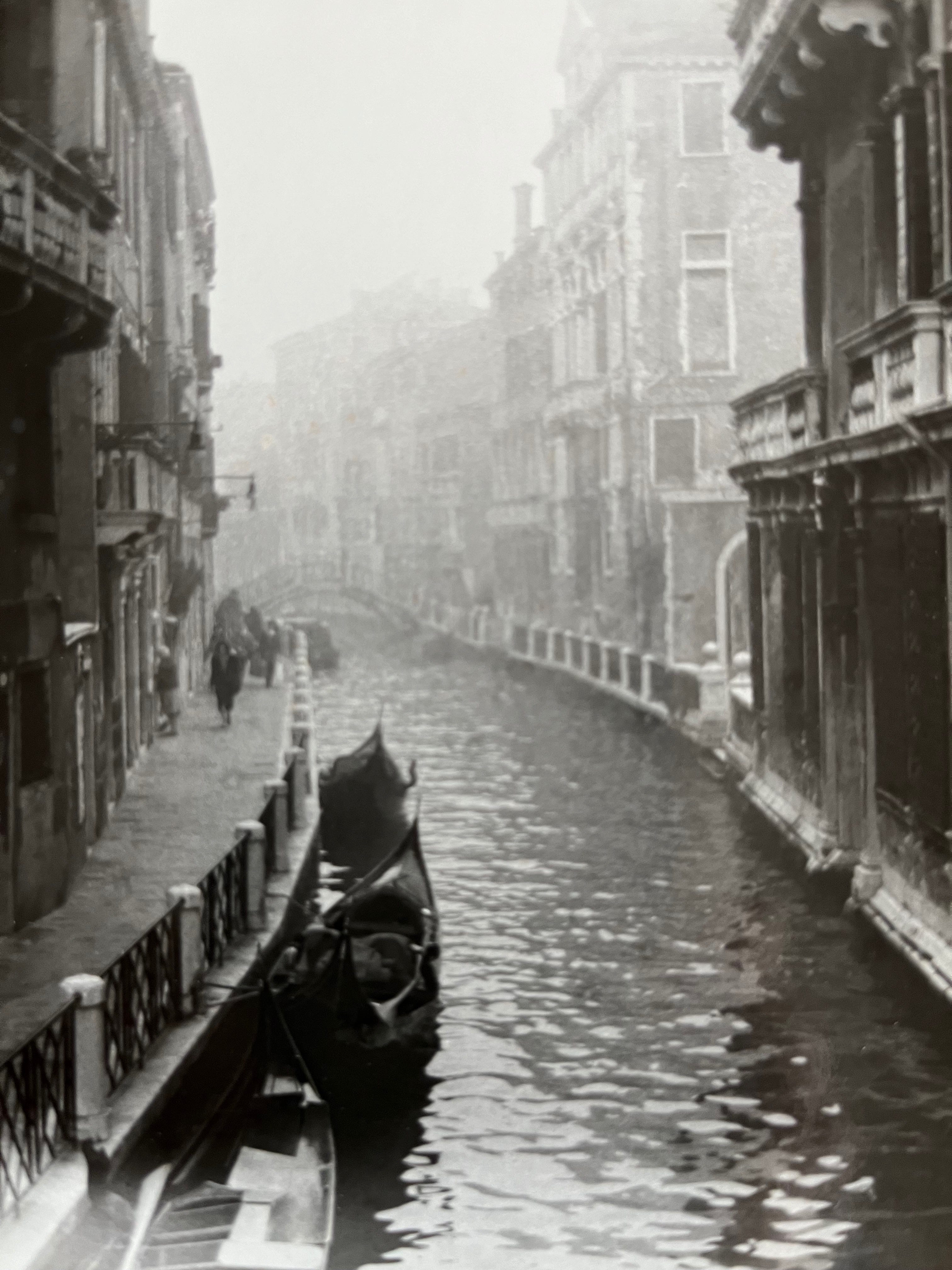
With each step, all of a sudden, homes and narrow paths emerged. We adjusted our eyes to the scene that seemed out of a film. Then, the first hints of color, and like an abundant river, a wave of anonymous figures began to come toward us, silent.
Piazza San Marco was dirty, yet alive—locals the protagonists, for once. A sight to behold. From muted pastels to vibrant hues, themed groups followed the rare lone silhouette. Velvet, satin, tulle, plumes, and feathers to tickle the curiosity.
They emerged from the fog, stopped to pose in a static tableau, then swooshed away floating in the fog and fading in the distance. They were gone, like in a dream suggestive of a different path—an invitation to admire the taking of new identities.
“Carnival, at its peak, exploded with masquerades and jests of every kind,” said Lord Byron in describing the Carnival in Venice.
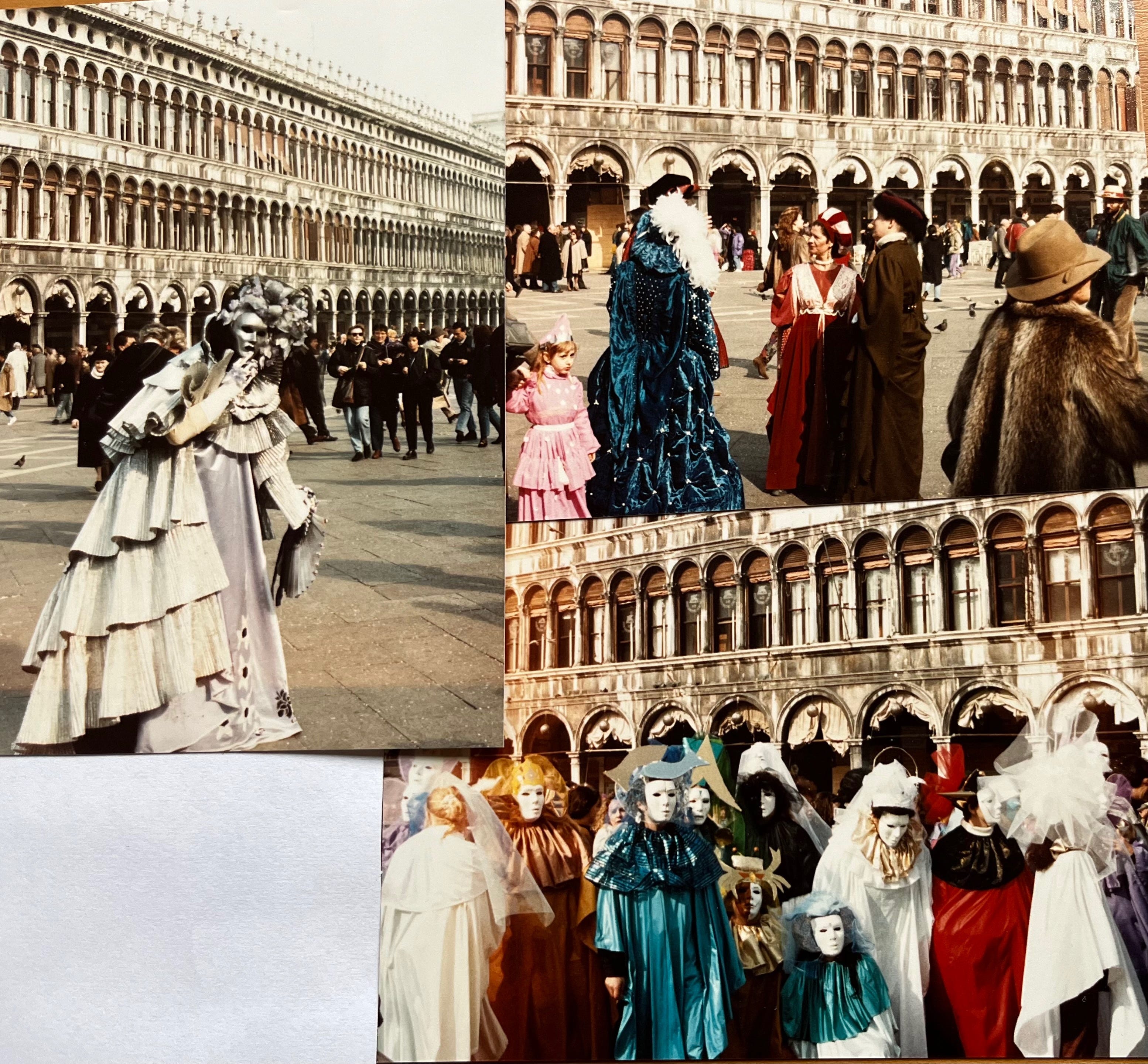
1990 was the last year I took the train up to Venice to participate in the city’s famous Carnival—a historical celebration that subverts the established social order and foments temporary chaos.
From its origins, the purpose of Carnival has been to resurrect a renewed cosmic balance.
Lent follows in short succession, but we don’t leave our masks behind. In fact, despite the claims of objectivity and rationality, humanity is in the thick of it. Partly because the need to drink, dance, celebrate, and subvert is a primary social force.
Although its etymology has Christian origins (Carnem levare, or ‘to deprive oneself of meat,’ which refers to the banquet that preceded Ash Wednesday on mardi gras), the origins of the Carnival rituals are much older.
“And it would be the most fun carnival to see the real faces of so many people.”
It’s a social celebration that takes place on the tail-end of winter and it expresses the human desire for freedom through the madness and transgression that’s in our soul. The last survival of the great social rituals of antiquity.
The mask—etymologically connected to the medieval Latin masca, for witch, spirit—was perhaps also a way to represent the world of the dead and souls, in that life-death dualism that has always characterized human existence and which finds its representation in the transition from winter, understood as the death of nature, to spring, seen instead as its rebirth.
“I would believe only in a God that knows how to dance.”
Nietzsche
Friedrich Nietzsche emphasized the act of dancing to highlight how freedom, creativity, and spirituality are interconnected. In dance, there’s a sense of liberation, spontaneity, and harmony that transcends the confines of rigid dogma or beliefs.
The Eleusinian and Orphic Mysteries were structured initiatory rites to emphasize purification, while the Dionysian Mysteries embraced ecstatic experiences. Dionysus is Lysios, ‘he who loosens,’ the liberator.
These mysteries resembled the tantric rituals in which human beings became acquainted with the wildest, most powerful, and freest part of themselves and experimented in ‘making soul.’
Carnival is a happy time, but also sad. Because it shows how the meaning and power of the ancient rituals—including a detoxification process of body and mind—has been domesticated, betrayed, vulgarized, and, with that, neutralized.
Literature is the only place where Carnival is still alive in its original nature, safe from the consumerism that enveloped it like a fog—concealing its healing properties, ready for the adventurous spirit.
Carnivalesque
Carefree or melancholic, dazzling or decadent, refined or repulsive, carnival in literature is much more than a simple backdrop. It’s a narrative device that reveals something about the ‘straight’ world.
“Who thinks about Carnival anymore? In contemporary life, I believe that fewer and fewer people remember or notice whether it’s Carnival or Lent. In books, however, I find myself reading references to Carnival more and more often, as if, now that it has faded from our direct experience, this custom assumed all its meaning, becoming a necessary element for understanding the ethnological foundations of Western civilization.”
- Italo Calvino, The World Upside Down
Medici’s Lorenzo the Magnificent composed the song ‘The Triumph of Bacchus and Ariadne’ for the Carnival of 1490. The title reveals its connection to the ancient Saturnalia: “How beautiful is youth that still flees! Whoever wants to be happy, let him be, for tomorrow is uncertain.”
But the fact that Carnival has lost its ritualistic value in our society creates a distance from it: this allows us to grasp the existence of a poetics of Carnival made up of recurring and symbolically dense motifs. Thus the narrative device, through the representation of an ‘upside-down world,’ reveals something about the ‘straight’ world (where perhaps not everything goes well, after all).
“I look upon the world for what it is: a stage on which each must play his part.”
William Shakespeare, The Merchant of Venice
The Russian critic Mikhail Bakhtin,1 focusing on the Carnival ritual in two of his famous studies on Fyodor Dostoevsky and François Rabelais, highlighted how, behind a façade of mere amusement, Carnival conceals a profound ambiguity, of a dramatic, bloody and almost Dionysian nature.
At the heart of the universe in Rabelais, author of Gargantua and Pantagruel, is “the second life of the people, organized on the principle of laughter.”2 L’amusement would then be charged with all that violently subversive support that motivates every desire for profound social and spiritual renewal.
Aspects such as the ‘low,’ the ‘degrading,’ the ‘scatological,’ and the ‘material’ of reality offer an image here and there of a ‘paradoxical’ society—an inverted image of order capable of revealing the fragility of the social norms of conduct that govern relationships between people in the ordinary course of their daily lives, and between these same people and any principle of authority, whether worldly or otherworldly.
Bakhtin calls it ‘Achieved Utopia’ that celebrates the continuity of collective life in the face of the fear of death and every form of power that limits and oppresses. A utopia that can only take shape in the authentically popular dimension of street life.
Organized around mockery and laughter, street life grants the right to a form of frankness and freedom of speech that is permitted only in the most festive and clownish of social contexts. It’s the “authentic celebration of time, of becoming, of change, and of renewal.”
All insurmountable barriers are torn down in the ritual—wealth, age, hierarchies.
And yet, melancholy quickly creeps into the festival of laughter. For example in Torquato Tasso’s3 rhymes, “The happy season returns, and in various forms, under false aspects, true lovers hide themselves, and beneath laughter, tears.”
Here we find the motif of the mask, which plays a dual role—it hides one’s identity, and it reveals the double. “The mask on the face with which one can tell the truth,” Gioachino Belli4 would say later.
In the 18th century, the motif of reversal loses its impact. In Carlo Goldoni’s5 Massere, the masters are no longer so inclined to play along. In a comedy by Goldoni, Harlequin is a mask linked to an ancient demon of the earth and agricultural rituals, an echo of which can also be found in Dante’s Inferno.
During the years of the Grand Tour, the depiction of carnival as a picturesque moment enjoyed great popularity, even reaching as far as Goethe in a short essay of his Italian Journey travelogue and Madame de Staël, who recount the celebrations in Rome. In 19th-century France, the Venetian carnival held great fascination, as seen in the works of Théophile Gautier.6
Certain themes, such as the exchange between social groups, by now had been buried. In his poem on Carnival, Giosuè Carducci7 depicts a time fraught with mournful elements, while Anton Chekhov, in The Eve of Lent, depicts the feast before fasting.
In the 20th century, Carnival was the undisputed protagonist of new writings of the Casanova myth: Stefan Zweig’s8 Casanova, Arthur Schnitzler’s9 The Return of Casanova, and Sándor Márai’s10 Casanova in Bolzano are a few.
The ambiguity of the celebration sometimes alludes to internal conflicts. “Evoè, carnevale!” in the opening lines of Jorge Amado’s11 O país do Carnaval, we hear the ancient cry of Bacchanal jubilation. The crowd packed into the streets is pervaded by a collective trance. The protagonist, recently returned from Europe, rediscovers the essence of his hometown and is overwhelmed by the excitement.
But after ‘samba-ing’ through the streets, he feels the need to distance himself from a land that represents the ‘victory of instincts’ and that, despite its apparent carefree nature, instills in him a feeling of ‘supreme desperation.’
One can see the fabrics of Karen Blixen’s12 Carnival in Venice. In the story, the ‘pandemonium’ of the party provides an opportunity to compare two eras—that of dazzling brocades and that of metallic, futuristic fabrics (which of the two eclipses the other is ‘a matter of taste’).
Blixen describes a society of seducers that would make Donatien Alphonse François, Marquis de Sade pale. One rule is imposed: “the cup of love is emptied in a single night, and the rest is dregs.”
“In a hundred years—I’ve been thinking—some other people will dress up as supper party of our period; of a 100 years ago to them. Let us be that tonight until tomorrow noon, a supper party of 2025. Masquerading as people of a hundred years ago. For it is a little silly to be a caricature of something of which you know very little and which means very little to you but to be your own caricature, that is the true carnival.”
And while Blixen initially conceived this story as a puppet comedy, Irène Némirovsky13 wrote The Carnival of Nice with a film script in mind. As in the Danish writer’s text, we find a love that lasts during a parade. The two protagonists are swept away by euphoria and discover a love that defines reason and convention: the celebration has the task of revealing the hypocrisies of bourgeois society and bringing to light repressed desires.
Once the celebrations end, with the traditional burning of the Carnival King, the regret remains for a happiness barely glimpsed and then immediately lost. “This is Bacchus and Ariadne, beautiful, and ardent for each other; because time flies and deceives.”
Carnival is a recurring theme in Giovanni Verga’s14 short stories, often seen as a tool for reshaping the social order. In Verga, carnival becomes a cry for freedom, emancipation, and an unexpected subversion of morality.
‘That furious Carnival of the month of July,’ begins in medias res (in the middle of things) with a cry of “Long live freedom!”—it’s the cry of revolt of the peasants who want to rebel against their condition of serfdom.15
Verga describes in particular the movement of the enraged, uncontrolled crowd, moving in front of the Town Hall like a stormy sea. The movement of the masses, armed with axes and sickles, quickly becomes an uncontrollable wave that submerges everything and ends in violence.
Halfway through the novella, when the Bronte uprising has reached its peak and is preparing to retreat, Verga describes it as a carnival parade, a furious July Carnival, therefore anomalous, because it’s out of season. In this subversive atmosphere, where established rules are overturned, the bell of the Church tolls—unheard:
“And in that furious July carnival, amid the drunken shouts of the hungry crowd, the bell of God continued to ring out in alarm until evening, without midday, without Ave Maria, as in a land of Turks. They began to disperse, tired of the carnage, dejected, dejected, each fleeing from his companion.”
The carnival atmosphere in Verga becomes synonymous with rebellion. Carnival is here also revisited in its original meaning as a pagan festival, as it doesn’t even hear the call to order (and truce) invoked by the church bell.
In ‘ntuppatedde of saint’Agata Verga describes how on the feast day dedicated to their patron saint, Saint Agatha, the women of Catania could parade through the streets and laugh, dressed as ‘ntuppatedde, their faces covered by a white veil, forgetting social conventions and asserting their freedom.
“In Catania, Lent comes without Carnival; but to compensate, there is the feast of Saint Agatha—a great revelry where the entire city is the theater—during which the ladies have the right to don masks under the pretext of intriguing friends and acquaintances, and to wander around wherever they want, however they want, with whomever they want, without their husbands having the right to interfere.”
There was a time in the 19th century, when the tradition stopped. The last ‘historical’ ‘Ntuppatedda, in 1868, was contested and booed by the crowd, a sign of changing times and a progressive erosion of tolerance towards this ancient custom.
But after more than a century, the ‘Ntuppatedde (‘ntuppari’, means ‘to close’, ‘to plug’, ‘to hide’) mingle once again among the crowds of devotees, free to move, to observe, to interact with men, protected by the anonymity guaranteed by their costume.
More than tradition, however, today it’s a performative act.
Laughter is sacred
The more Carnival fades among the celebrations that annually color our festive imagination, the more, our perception of Carnival as a celebration fades, the more theories about this custom increase. In other words, we think about what’s been lost.
Friedrich Hegel was correct when he said that a phenomenon can be rationalized and incorporated into philosophical reasoning concretely only on condition that its concrete vitality now belongs to the past.
Laughter and lightness are demonstrations of freedom. Which is why violence and authority are never caught in them. Tradition puts laughing with folly, but it more likely keeps company with wisdom.
“He who never laughs is not a serious person.”
Charlie Chaplin
According to Bakhtin, the medieval carnival spirit, dissolved in modernity, has flowed into literature, particularly the novel. It’s not only the categories of the genre grotesque and satire that are part of the process, but also the fundamental characteristic of literature: language.
Literature perpetuates the spirit of the medieval carnival in which opposites dissolve, otherness becomes identity, and wealth ceases to be a discriminating (linguistic) characteristic.
It breaks down boundaries, taking us by the hand and leading us on a journey that, if it doesn’t always provoke laughter, always establishes an alternate universe—making us imagine new possibilities of being in the world, of creating the world in our every gesture, bringing us closer to the different, the other, and thus broadening our horizons to encompass opposites.
Exactly as happened during Carnival.
A reminder that supporters receive access to series, extra topic break-downs at The Vault and can view the full archives, including online-only updates to essays.
In the middle of the twentieth century, Russian philosopher and critic Mikhail Bakhtin (1895-1975) coined a term that has since become indispensable to literary analysis: the ‘carnivalesque.’ It refers to the moments in literature when hierarchies dissolve, rules are suspended, and the world flips upside-down.
Michail Bakhtin, Rabelais and his World (translation by Sergeiy Sandler, The MIT Press, 2025)
Torquato Tasso (1544–1595) was an Italian poet of the 16th century, known for his 1581 poem Gerusalemme liberata, in which he depicts a highly imaginative version of the combats between Christians and Muslims at the end of the First Crusade, during the Siege of Jerusalem of 1099.
Gioachino Belli (1791–1863) was an Italian poet, famous for his sonnets in Romanesco, the dialect of Rome. His sonnets were often satirical and anti-clerical, as when he defined the Cardinals as ‘dog-robbers,’ for example, or Pope Gregory XVI as someone who kept ‘Rome as his personal inn.’
Carlo Goldoni (1707-1793) was a playwright and librettist from the Republic of Venice. His works include some of Italy's most famous and best-loved plays. Audiences have admired the plays of Goldoni for their ingenious mix of wit and honesty. His plays offered his contemporaries images of themselves, often dramatizing the lives, values, and conflicts of the emerging middle classes.
Théophile Gautier (1811-1872) was a French poet, dramatist, novelist, journalist, and art and literary critic.
Giosuè Carducci (1835-1907) was a poet, writer, literary critic and teacher. Regarded as the official national poet of modern Italy, in 1906, he became the first Italian to receive the Nobel Prize in Literature. The Swedish Academy awarded him the prize “not only in consideration of his deep learning and critical research, but above all as a tribute to the creative energy, freshness of style, and lyrical force which characterize his poetic masterpieces.”
Stefan Zweig (1881–1942) was an Austrian writer. At the height of his literary career in the 1920s and 1930s, he was one of the most widely translated and popular writers in the world.
Arthur Schnitzler (1862–1931) was an Austrian author and dramatist, considered one of the most significant representatives of Viennese Modernism. Schnitzler’s works, which include psychological dramas and narratives, dissected turn-of-the-century Viennese bourgeois life, making him a sharp and stylistically conscious chronicler of Viennese society around 1900.
Sándor Márai (1900–1989) was a Hungarian writer, poet, and journalist. His Casanova in Bolzano was a joyous romp, an eloquent and fast-moving discourse on love, about 90 percent of the book takes place in one room, where the stage is set for what amounts to a literary operetta.
Jorge Amado (1912-2001) was a Brazilian writer of the modernist school. He remains the best-known of modern Brazilian writers, with his work having been translated into some 49 languages and popularized in film, including ‘Dona Flor' and Her Two Husbands’ in 1976, and having been nominated for the Nobel Prize in Literature at least seven times.
Baroness Karen Christentze von Blixen-Finecke (1885–1962) was a Danish author who wrote in Danish and English. She’s best known for Out of Africa, an account of her life while in Kenya, and for one of her stories, ‘Babette’s Feast.’ Both have been adapted as films and each won Academy Awards.
Irène Némirovsky (1903–1942) was a novelist of Ukrainian Jewish origin who was born in Kiev, then in the Russian Empire. She lived more than half her life in France and wrote in French, but was denied French nationality.
Giovanni Verga (1840-1922) was an Italian realist writer. His novels I Malavoglia and Mastro-don Gesualdo are widely recognized as masterpieces. Verga has been called the greatest Italian novelist after Alessandro Manzoni.
Based on actual events, as I learned in Garibaldi: Citizen of the World: it’s the genesis of the Bronte uprising, which took place in the Sicilian town in August 1860, and its repression by Garibaldi’s lieutenant, General Nino Bixio.