

Solitary
Social contact is a necessary part of being alive, critical to survival; community a vital aspect of being human.

When we have no idea of what’s happened to people before our time, we become weaker in our understanding of the world. Because to know history is to put one’s world into perspective—its values, its institutions… how did they emerge, came to be?
For example, take the Pope (from Greek πάππας, father). For a thousand years, bishops were all the same and nominated by the people locally. Only in 1059, during the pontificate of Nicholas II, was a college of cardinal electors established to choose the pontiff and limit external interference.
The first true conclave (from Latin cum clave, ‘with key,’ because the electors are locked in) took place in 1241, although the procedure was only formalized in 1274 by Gregory X. Held in Viterbo, the papal election of 1268-1271 was the longest in the history of the Catholic Church.
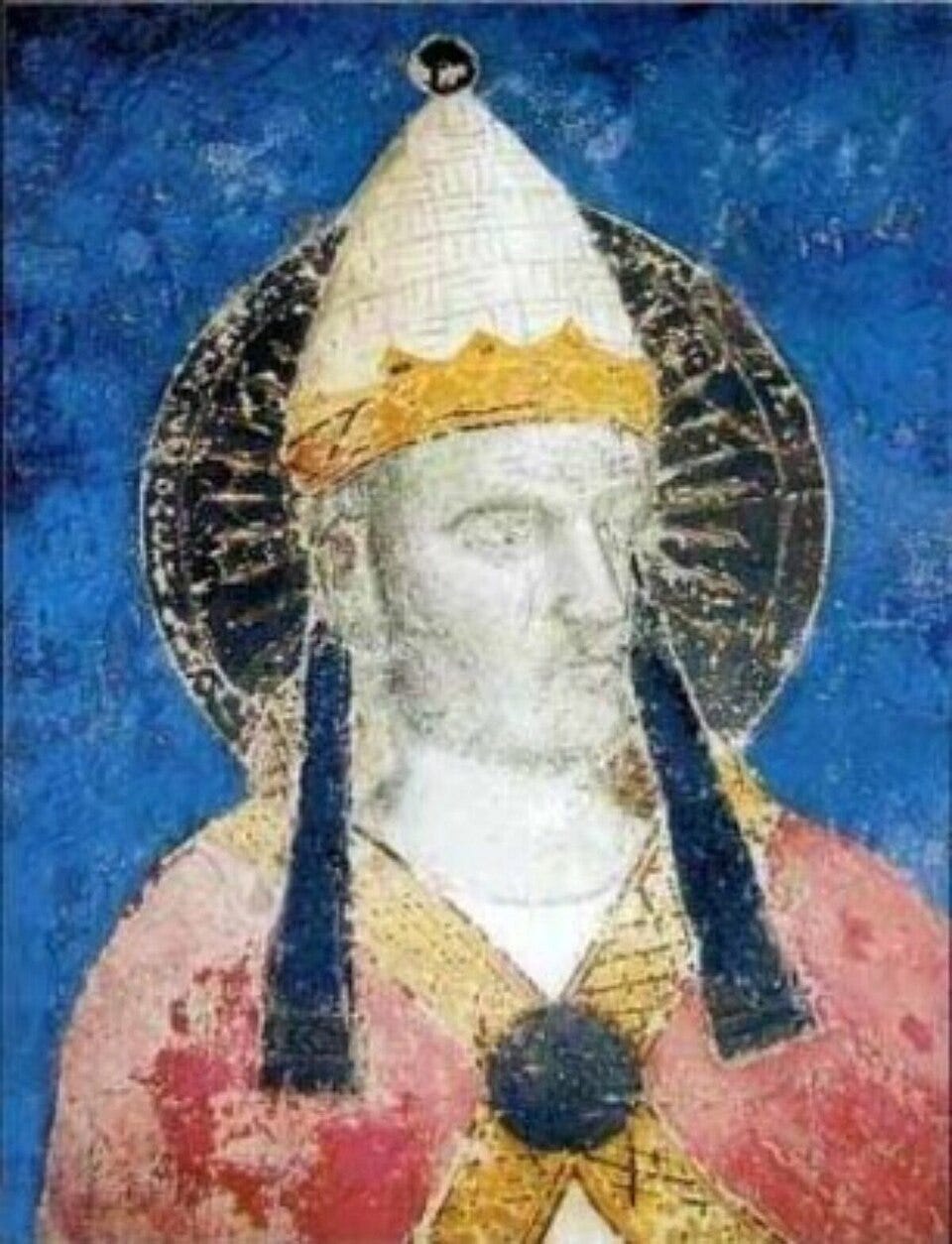
Sacred things have been invented at a certain time—celibacy after the year 1000 is another example. For centuries priests married and had children. It was only in the Middle Ages that the Latin Church imposed the ban on marriage for those who took vows.
Mandatory celibacy was a decision taken in the councils of the 12th century, and its introduction responded to both spiritual and material and political interests.
Many high officials, including popes, had unrecognized children they officially called ‘nephews.’ A well-known case is that of Pope Alexander VI (Rodrigo Borgia) with his children Cesare and Lucrezia. This wasn’t uncommon; others behaved more discreetly.
The word ‘nepotism’ derives from the Latin nepotes (nephews) because of the practice of politically advancing these unofficial children.
In my notes about the invention of the sacred, I jotted down a quote: “Only positive degrees of good have meaning and efficacy.” To say it was Christopher Burney, an upper-class Englishman who served in the Special Operations Executive (SOE) during World War II.
Later in the war, Burney was captured by the Germans and spent 18 months in solitary confinement. How could a man forced alone under physical and emotional abuse, extreme weather conditions, and provided very little food survive?
“Only positive degrees of good have meaning and efficacy.”
Confined in isolation, when they gave Burney an opportunity to communicate “…I found that the muscles of my mouth had become stiff and unwilling and that the thoughts and questions I had wanted to express became ridiculous when I turned them into words.”1
Routine was how Burney maintained mental equilibrium. He divided his day into fixed periods—he did things like fingernails manicure, physical exercises, and pacing in his cell at strict intervals. His only daily meal he split between afternoon and evening. Once while allowed to exercise outside he found a snail, he brought it back to his cell for company.
It was this strict routine that allowed him to keep his sanity and protect his psyche’s health first at Fresnes Prison, then at Buchenwald’s extermination camp. He wrote about life in Buchenwald in Dungeon Democracy (1946). Solitary Confinement (1951) is his account of his 15 months in Fresnes Prison.
Though he was strong and steadfast during imprisonment, the experience chased him the length of his life. At the conclusion of Dungeon Democracy he asks the same questions we’re asking today:
“Now, we are at a crisis. In the next years, the balance will fall. On one side lies this idea of right, of reasoned self-discipline and a search for justice; on the other, evolution to a world of herds, led plunging and fighting for material gain by a few godless megalomaniac bulls.”
Solitary confinement is one of the cruelest impositions one can give to a human—a form of slow torture. Dr. Fromm-Reichmann studied loneliness in various forms: culturally determined, solitude experienced in nature, and temporary isolation.
She says, “The longing for personal intimacy stays with every human being from infancy throughout life; and there is no human being who is not threatened by its loss.”
We’re born with the need for contact and tenderness. If we don’t get them early in our development, we find refuge in fantasy. But that in itself forces us to a solitary life. People in this condition tend to have difficulty distinguishing reality from fantasy.
Fictional narrative is the result of isolation. It’s a phenomenon brought about by the rise of “technocracy and cultural disconnection, competitiveness at the expense of cooperation, and, consequently, psychological polarization.”2
To those barriers that prevent the “living in accordance with one’s values,” I’d add the progressive distancing from religion in society. Technocracy does ‘break souls’ when humans are more susceptible, when ‘packaged, programmed, and businesslike’ interactions have replaced community-based rituals of worship and social life.
In the absence of a community, routines are a form of personal ritual. We establish them for the same reason— to stabilize life. Hannah Arendt said that it’s the durability of things that gives them their ‘relative independence from men.’ They ‘have the function of stabilizing human life’. Their “objectivity lies in the fact that . . . men, their ever-changing nature notwithstanding, can retrieve their sameness, that is, their identity, by being related to the same chair and the same table.”
Through self-sameness, repetitiveness, routines and rituals stabilize life. The contemporary compulsion to produce robs things of their endurance—to increase production and force consumption, we erode quality, thus duration.
Despite all of this, the competitiveness, the race to ‘best’ that is a major contributor to isolation and separation, and beyond defensive routines to stave off solitude, some rituals endure (thought they’ve been mostly co-opted by commerce and consumption.)
Easter is one of the most important religious and cultural holidays in the Christian calendar. Celebrated in spring, this holiday commemorates the resurrection of Jesus Christ, which—according to the Gospels of the New Testament—occurred on the third day after his crucifixion on Mount Calvary on Nisan 15, 32 AD.
In Christianity, Easter represents the fulcrum of faith: it’s the fulfillment of the message of love, sacrifice, and hope preached by the historical person Jesus. It’s the culmination of his passion.
The traditions of Easter and Easter Monday embody the essence of Italian culture. They blend reverence for religious customs through solemn processions and heartfelt prayers with joyful celebrations and culinary delights in lively picnics and feasts.
It’s a time of profound significance and communal joy as families come together to honor age-old traditions and create lasting memories.
The reason why Easter is not a fixed day like Christmas is that the date of the celebration coincides with the Sunday following the first full moon of spring.
In Piedmont, tradition calls for the preparation of kid goat, often grilled or baked. In Lombardy, the typical dish is lamb, cooked with rosemary and served with seasonal side dishes. In Veneto, the most characteristic Easter dish is Fugassa, while in Calabria you can try cuzzupe, traditional Easter sweets, and in Campania, casatiello and pastiera.
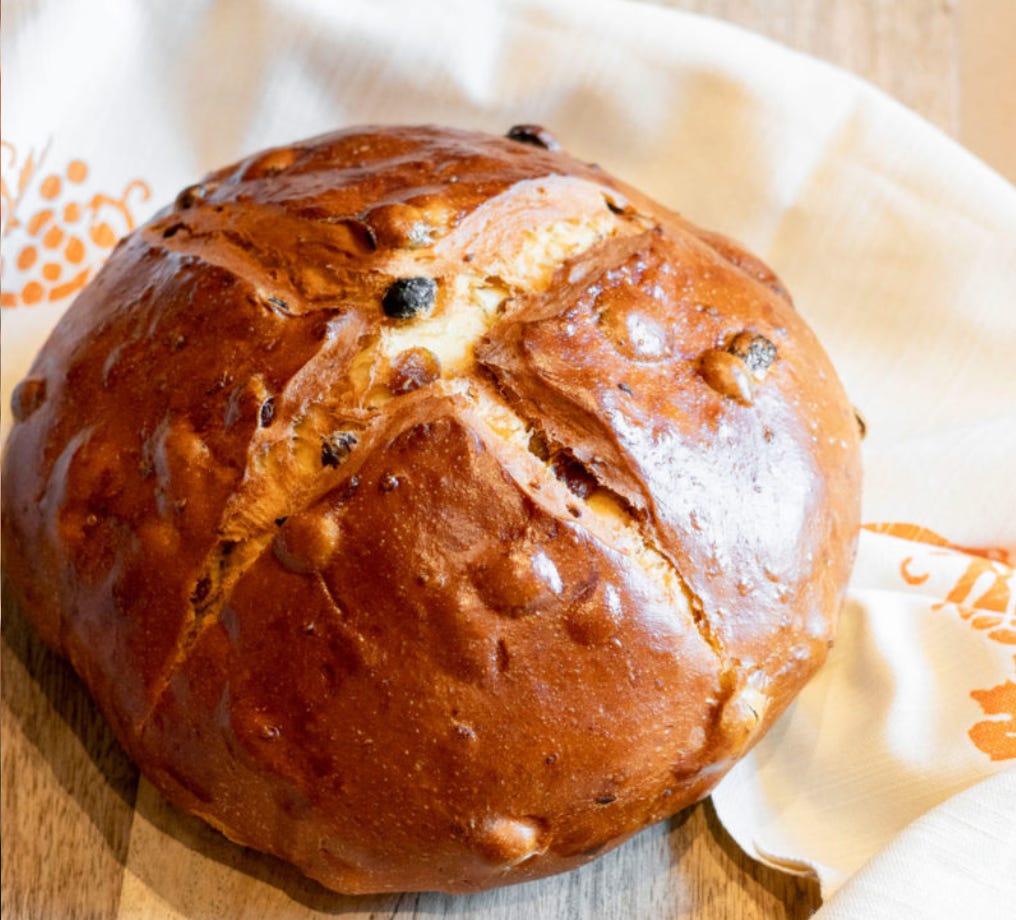
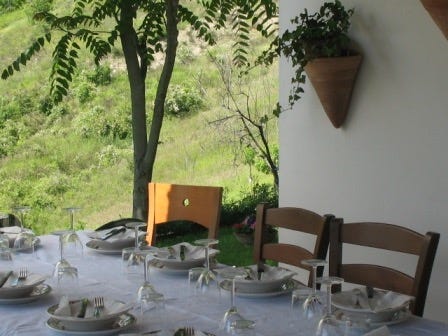
Wild narcissus blooms in the Tuscan-Emilian Apennine National Park. And after the abundant shared meal of Romagna loaf eaten with blessed eggs, salami, and Sangiovese wine the day before, the Easter Monday walk is an ancient tradition throughout Emilia-Romagna, my region.
In a world were moral values are consumed as marks of distinction, Easter is a universal invitation to hope, to the possibility of starting again even after difficult times. Eggs are an emblem of rebirth, fertility and hope. In Egypt, the egg represented perfection and harmony between the four elements: earth, air, water and fire.
I love to walk alone in nature, and I enjoy the self-imposed temporary solitude to write and think, but I consider the loneliness imposed in a technocratic society poisonous. To that, I prefer the solitary reading of a poem, as necessary to play with the fuzzy edges of our shared humanity.
For this special weekend (long in Italy), I recommend Emily Dickinson’s ‘A Light exists in Spring.’
A Light exists in Spring
Not present on the Year
At any other period -
When March is scarcely here
A Color stands abroad
On Solitary Fields
That Science cannot overtake
But Human Nature feels.
It waits upon the Lawn,
It shows the furthest Tree
Upon the furthest Slope you know
It almost speaks to you.
Then as Horizons step
Or Noons report away
Without the Formula of sound
It passes and we stay --
A quality of loss
Affecting our Content
As Trade had suddenly encroached
Upon a Sacrament
A reminder that supporters receive access to series, extra topic break-downs at The Vault and can view the full archives, including online-only updates to essays.
Source: Fromm-Reichmann, 322. Born in Karlsruhe, German, Dr. Frieda Fromm-Reichmann (1889-1957) was an internationally recognized pioneer in the treatment of mental disorders. She lived and worked in this house from 1936 until her death in 1957. After she had fled Nazi Germany in 1935, Dr. Dexter Bullard recruited her to help expand Chestnut Lodge into a therapeutic community that combined psychoanalysis and occupational therapy.
She believed in the voluntary acceptance of life’s commitments and in acquiring the strength to accept criticism. Fromm-Reichmann stimulated the application of linguistic and communications research to psychoanalysis, when participating in 1955 and 1957 at the Center for Advanced Studies in the Behavioral Sciences, Stanford, California.
Source: Fromm-Reichmann’s (1959/1990) Real Loneliness in the Contemporary United States, Andrew M. Bland.