


I write essays such as this one to understand better the complexities of the past, so I can find a path to the future. To do so involves not just re-learning how to think about events in a more comprehensive light, but to value the nuance of how language and narrative influence culture.
Unknown at the time, the son of an accomplished musician, he upset the world and its order from there on. But he didn’t pull his concepts out of thin air—they were the fruit of developments in science by others before him, and his own observations.
I’ve read quite a bit about him over the years both about his discoveries and the controversies that surrounded them. His namesake museum in Florence is filled with tools that were part his invention.
Born in the period we now call the late Renaissance, Galileo Galilei1 followed illustrious scientists with his work. But his most remarkable quality was to be a skilled communicator—and that strength both condemned and saved him.
A reminder that supporters receive access to series, extra topic break-downs at The Vault and can view the full archives, including online-only updates to essays.
Galileo has long fascinated me. First off, as a scientists, he published in Italian, not Latin—and that was already innovative. He was also a voracious reader—a fan of poets Ludovico d’Ariosto’s Orlando furioso2—and could recite Dante’s Commedia.
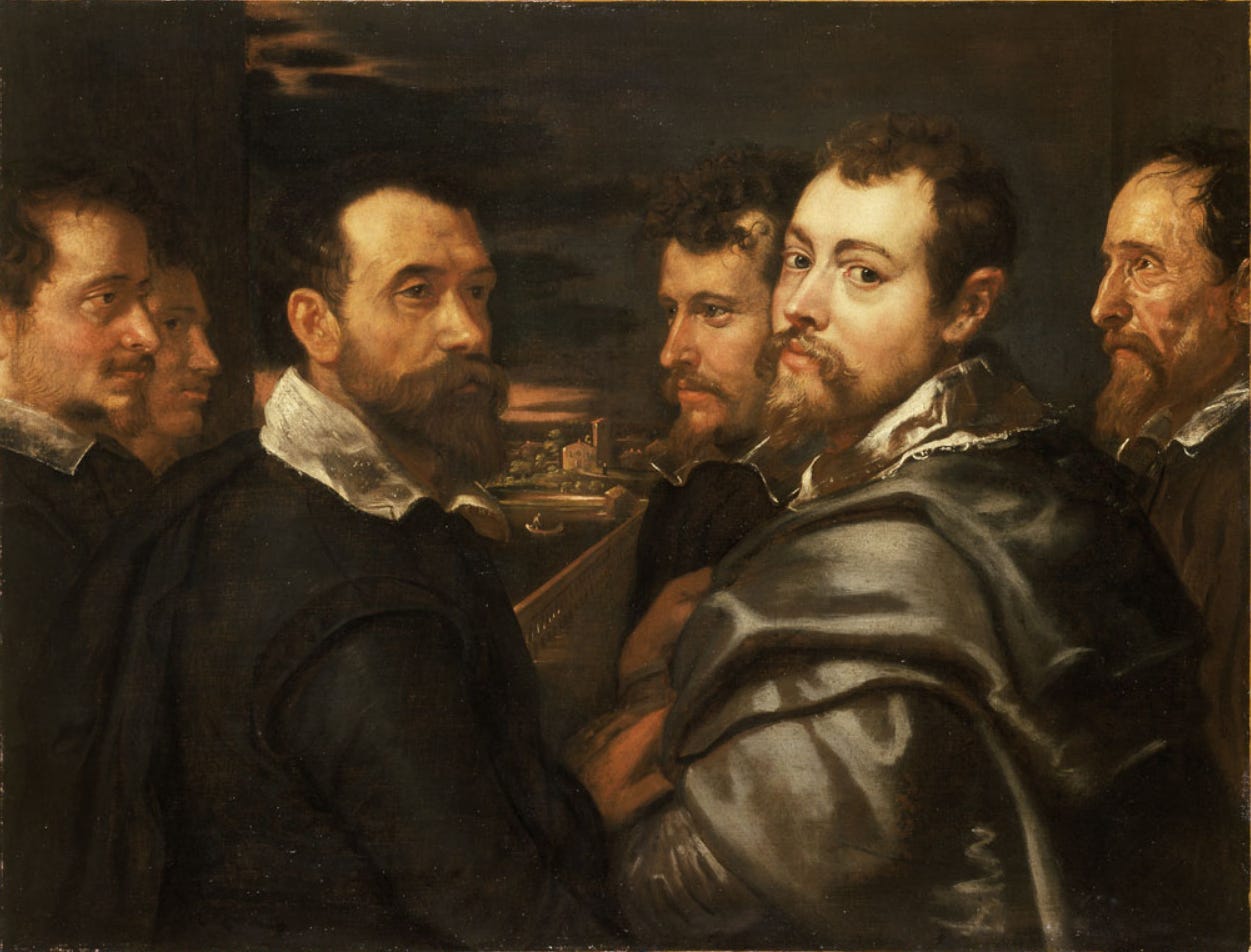
He also got his hands on two books that would change humanity’s views of macrocosm and microcosm, both published in 1543: Nicolas Copernicus’ On the Revolution of the Heavenly Spheres, and Flemish anatomist Andrea Vesalius’ On the Fabric of the Human Body.
A new understanding of the universe was possible in the sky and in our bodies. Their work went against prevailing beliefs that had dominated common scientific discourse since antiquity.
While Greek philosophers viewed people as members of a larger community, individualism was an emerging socio-psychological element of the late sixteenth, early seventeenth centuries—a person could achieve self-fulfillment, irrespective of circumstance.
Plato’s The Republic3 spoke of a better society, the council of wise men led to the Catholic Church and the Protestant movement’s rebellion and René Descartes’ ‘I think, therefore I am.’4
Printing was the new technology that helped create the standardization of knowledge. It also helped mathematics as diagrams were easier to reproduce—from Euclidean geometry to Archimedes, who was Galileo’s role model for his experimental method.
Mathematician Luca Pacioni wrote and published The Collected Knowledge of Arithmetic, Geometry, Proportion and Proportionality,5 documenting double-entry bookkeeping for the first time.
Explorers Christopher Columbus6 and Vasco da Gama7 stoked tremendous curiosity about new worlds. By the 1520s, humans had already circulated the globe and opened up new horizons for European exploration (and colonization.)
Against this very brief historical background is Galileo’s key chronology:
- 1583 he dropped out of medical school and began the study of mathematics
- 1590, at 26, he criticized Aristotle’s teachings on motion (a built-in impetus)
- 1603 experiments with inclined planes and pendulum and formulated his first ‘law of motion’ regarding free-fall (published subsequently in 1638)
- 1610 first discoveries with the telescope
- 1615 the letter to the Grand Duchess Christina where he interpreted biblical language based on science
- 1630, on May 15, he’s received in Rome as honored guest of Pope Urban VIII (post-reformation); the politics are delicate: “facts, which at first seem improbable, will, even on scant explanation, drop the cloak, which. has hidden them, and stand forth in naked and simple beauty.”
- 1632, on February 21 Dialogue Concerning the Two Chief World Systems8 went to press
- 1633 he’s tried by The Inquisition, pronounced a suspect heretic, forced to recant Copernican ideas, and is put under house arrest
- 1634 sister Maria Celeste, his daughter, dies; Discourses and Mathematical Demonstrations Relating to Two New Sciences is published in Nederlands; John Milton visited
- 1642 died at Villa Arcetri, near Florence, blind
But a mere list of dates and major events does not make a life, nor its legacy. For a more comprehensive reading of those events and milestones, we need to backtrack to a simple 45-page illustrated book that relates the story, what preceded it and what came after.
Return to the beginning
In many ways, seventeenth century religious, social, economic, and cultural problems are similar to today’s. There are conflicts between religion and science, creationism issues, attacks on intellectualism and expertise…
Keep reading with a 7-day free trial
Subscribe to On Value in Culture to keep reading this post and get 7 days of free access to the full post archives.