


I write essays such as this one to understand better the complexities of the past, so I can find a path to the future. To do so involves not just re-learning how to think about events in a more comprehensive light, but to value the nuance of how language and narrative influence culture.
All too often, the irony of the past escapes us due to a lack of context. So in order to understand the cartoons that popped up in Britain during the early nineteenth-century and became known beyond England, it’s useful to take a look at what was happening during that time.
History calls the period that went roughly between the years 1795 and 1837 Britain’s Regency era, though the regency proper spanned just a shorter time—from 1811 to 1820, which marks the year of George III’s death.
The late king was not doing so well—he first suffered debilitating illness in the late 1780s, and relapsed into his final mental illness in 1810. In his stead, the socialite Prince of Wales was appointed Prince Regent,1 and later named George IV.
It was a time of great change—advancements in technology and distributed wars created economic difficulties, mass population relocations and growth presaged large shifts in society. Here, I explore a cultural phenomenon that captured the moment.
A reminder that supporters receive access to series, extra topic break-downs at The Vault and can view the full archives, including online-only updates to essays.
I’ve recently discovered that before the events that precipitated a broader use of cartoons to poke fun at the noble, there was a book. The coronation of George III coincided almost to a ‘T’ with the publication (1762) of the first English book about caricature.2
That itself is significant, as phenomena rarely come out of thin air. And they take hold on fertile terrain.
Regency England was a time of refinement and culture among the wealthy. Celebrity writers included Romantics like Jane Austen, William Blake, Lord Byron (the original teen heartthrob), John Constable, John Keats, John Nash, Ann Radcliffe, Walter Scott, Mary Shelley, Percy Bysshe Shelley, J. M. W. Turner and William Wordsworth.
Many of these authors and their stories continue to fire contemporary imagination3—Bridgerton and the gossip of the ‘ton’ complete with ornate ballroom parties and budding romances a-la-Austen are contemporary television hits.
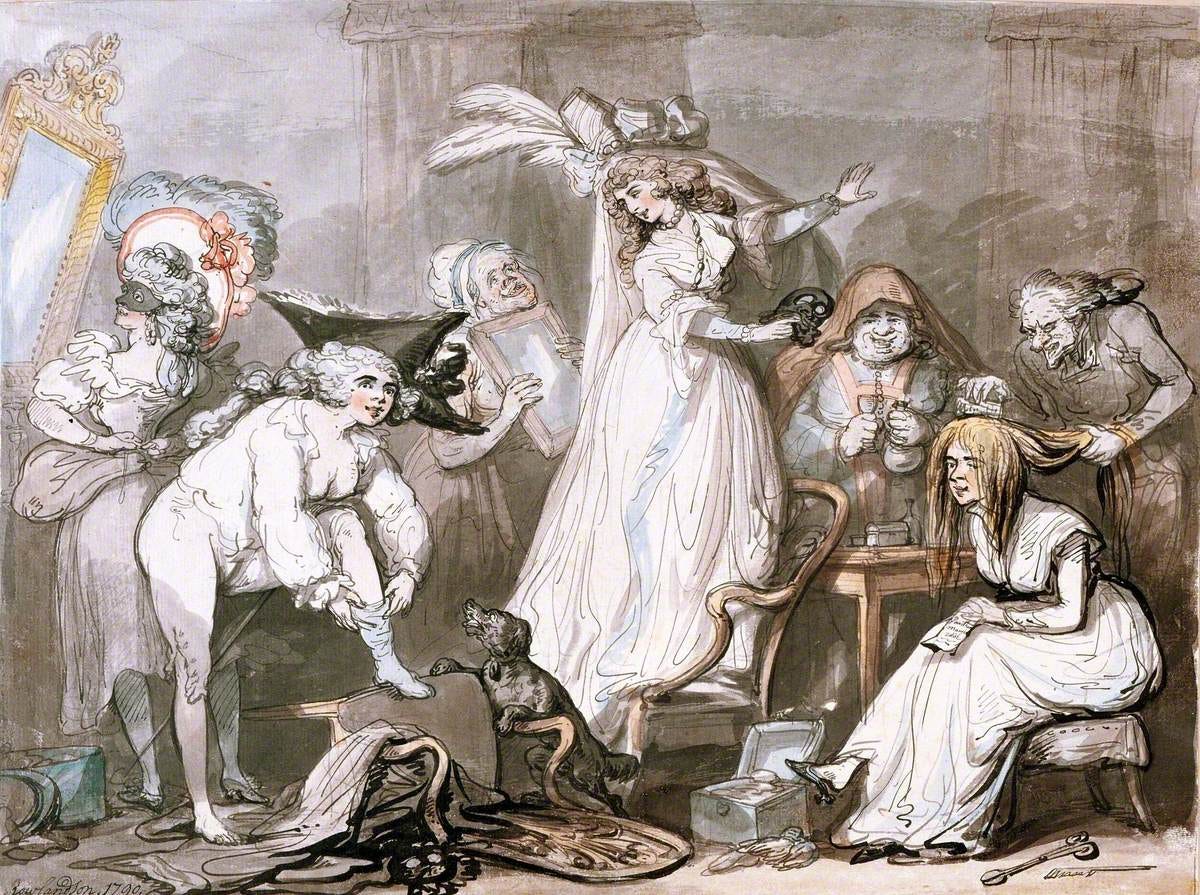
But it was not all roses, picnics, and countryside balls—cities were filthy, wars were still raging, and famine was one short ruinous crop away.
The Industrial Revolution, Napoleonic Wars and the aftermath of the French Revolution and American Independence created large scale social strife and political changes. Together with technological advancements, all these factors altered British society permanently.4
While urban population density was rising due to industrial labor migration, the many had to contend with the impact of war, mass unemployment, and economic collapse. People were forced to live in slums; a single bad harvest in 1816 was devastating against a boom in births.5
Free expression was encouraged in the Age of Enlightenment. And the Georgian Era spun what they called the ‘Golden Age’ of caricature—satirical prints with risqué illustrations of scandalous affairs and humorous digs at London’s elite.
I first came across the phenomenon in a period fiction book. Author Andrea Penrose spins a yarn that sees the enigmatic and science-friendly Earl of Wrexford and London’s most popular satirical cartoonist, A.J. Quill, eventually face each other.6
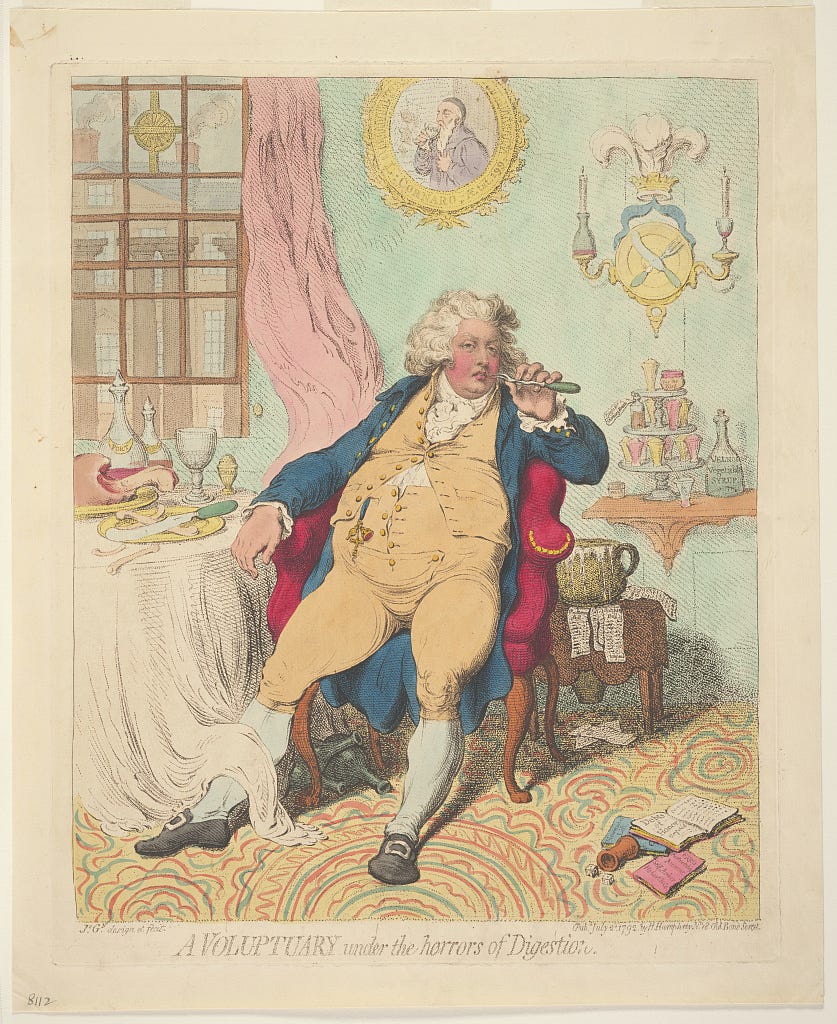
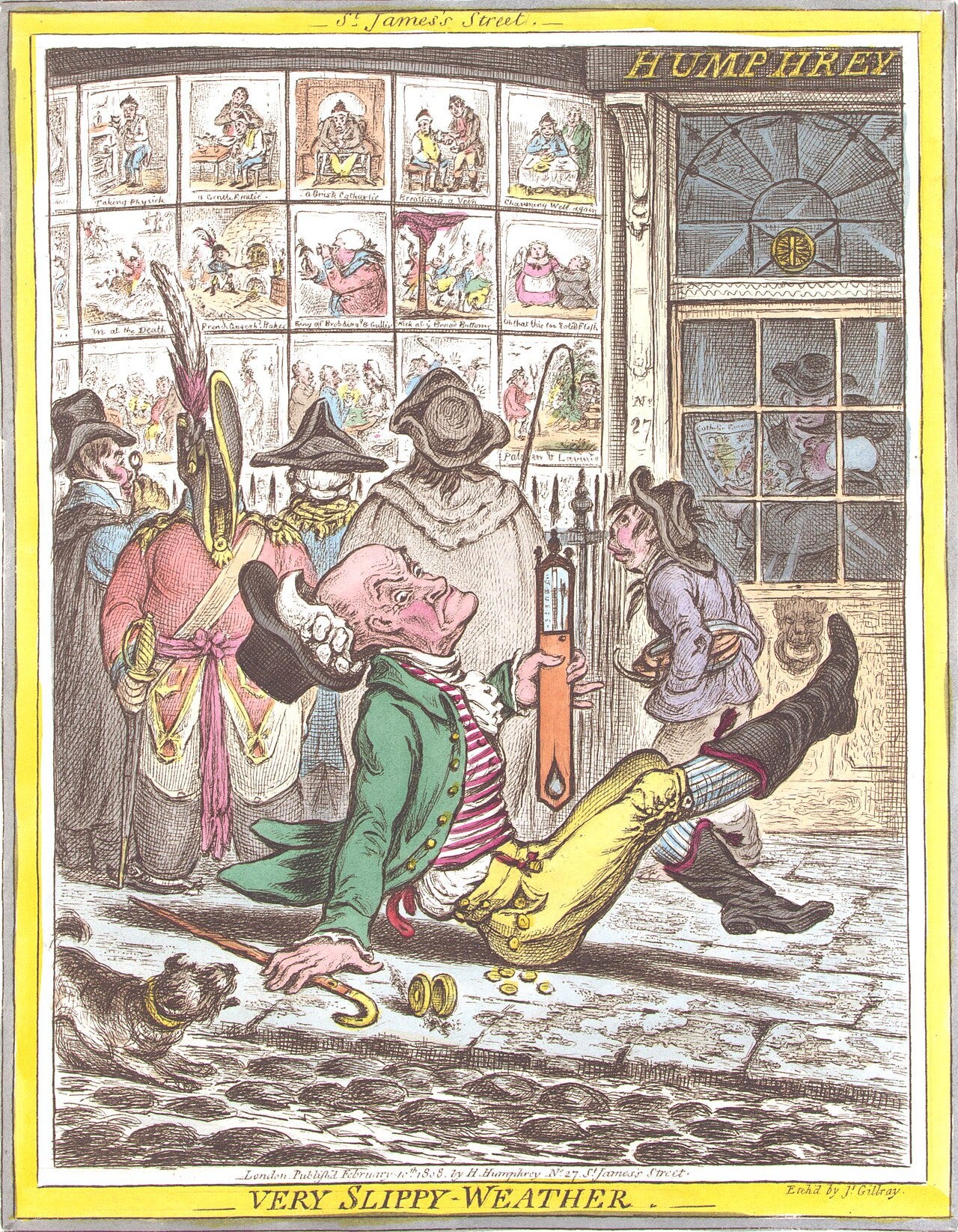
However much we’d like to imagine these to be some precursor to the anti-authoritarianism of underground comics, the bite-sized prints were priced beyond the pockets of regular folk, though they could see them posted on print shop windows.
The novelty was that it was the personal character of the satire embodied in the prints of the Georgian era to give them their edge at the time (a characteristic that makes them often obscure now—we lack the context and ‘temperature’ of the age).
Caricaturists seem to have been more willing and able to cross with impunity a line than writers: that of insult, libel, accusations of bizarre sexual acts, etc. Prints could be bought, sold, and viewed in private; libel prosecutions were rare.
Print satire used humor, irony, or exaggeration to ridicule or criticize at the expense of the powerful and famous. It was used especially as a form of commentary to check social conscience in an attempt to hold political leaders accountable for their actions.
Mockery and prophecy
Keep reading with a 7-day free trial
Subscribe to On Value in Culture to keep reading this post and get 7 days of free access to the full post archives.